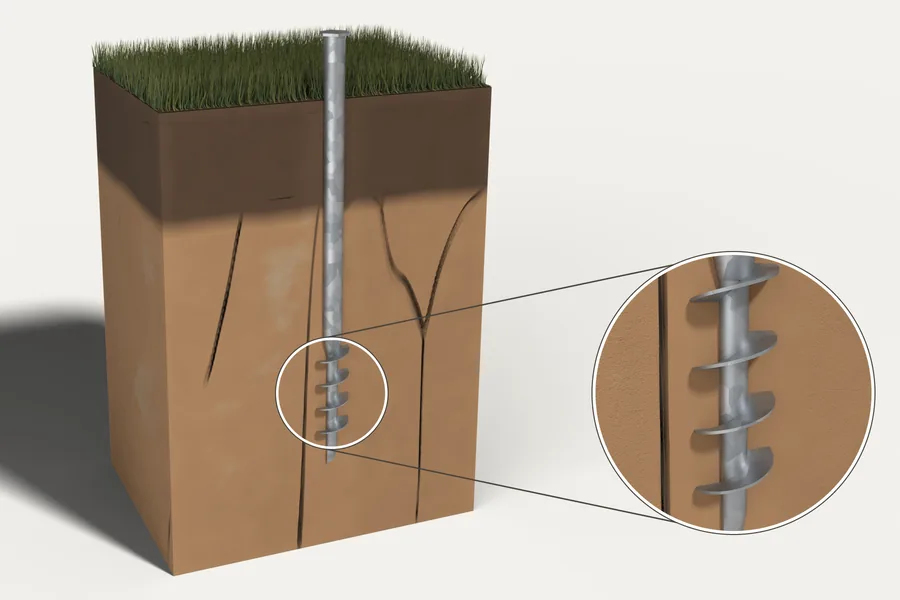
What are ground screws?

Ground screws are used more and more in construction, but not everyone knows exactly what they are or how they work. This article explains, in simple terms, what screw foundations are and why they are becoming an alternative to concrete.
This article is the short version. For the complete guide, with installation steps, soils, applications and the comparison with concrete, read ground screws: the complete guide.
What ground screws are
Ground screws, or screw foundations, are steel elements that are screwed into the ground to create a stable base to build on.
Unlike conventional foundations, they:
- Need no major excavation
- Use no concrete
- Are ready to use straight away
- Are sustainable
- Can be reused
How they work
The principle is simple: the screw is driven into the ground by rotation, going down until it reaches a stable layer.
This makes it possible to:
- Spread the load
- Provide stability
- Limit ground movement
What they are used for
Ground screws can be used for many applications, including:
- Prefabricated houses
- Timber structures
- Gazebos and pergolas
- Benches and street furniture
- Solar and agrivoltaic installations
- Beach structures
- Fences
- Temporary or permanent installations
Why more and more people use them
In recent years, more and more people have chosen ground screws because they offer:
- Quick installation
- Minimal impact on the ground
- No waiting time
- Removal and reuse
- More flexibility than concrete
Are they suitable for everyone?
In most cases, yes. Screw foundations are very versatile and can be used in many types of soil, with a few exceptions.
Conclusion
Ground screws are a modern, simple and effective way to build solid bases without concrete. Want to know if they suit your project? Contact T-Block for advice.