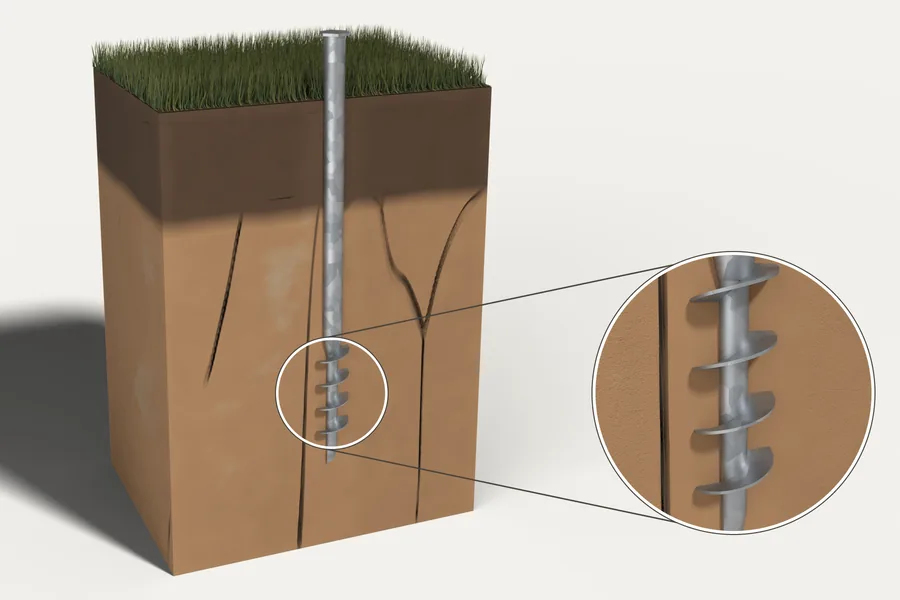
How do ground screws work?

Ground screws are a simple, effective way to build stable bases without concrete. They work on a precise mechanical principle that transfers loads to the ground safely and reliably.
Here you get the principle in short; the complete guide to ground screws adds the installation methods, soils, load ranges and completed projects.
The working principle
Screw foundations are driven into the ground by rotation until they reach the required depth.
Stability comes from the interaction between:
- The geometry of the screw
- The type of soil
- The installation depth
When the screw is installed correctly, the screw and the soil work together to hold the load, with no invasive works needed.
The installation steps
The process is quick and well defined:
- Soil assessment. It is essential to know what kind of ground you are dealing with.
- Choosing the T-Block. The screw is selected according to the soil and the structure to be installed.
- Pilot hole (if needed). In some cases a pilot hole is drilled to make installation easier.
- Screwing in. The screw is driven into the ground to the required depth.
- Connecting the structure. Once the screw is in, the structure can be fixed straight away.
How it differs from concrete foundations
Compared with the conventional method, ground screws need no:
- Excavation
- Formwork
- Reinforcement
- Concrete pour
- Curing time
- Striking of formwork
In many cases, no heavy machinery is needed either.
This makes installation:
- Faster
- Cleaner
- Less invasive
A system that adapts
The working principle is always the same, but it is adapted to:
- The type of soil
- The size of the screw
- The type of structure
Some models can be installed by hand, while others need machines. See the installation methods.
Conclusion
Ground screws work thanks to a simple but precise system that uses the interaction between screw and soil to provide stability. Contact T-Block to choose the right solution for your project.