T-Block ground screws vs concrete footings: which should you choose?

Choosing the foundation system is a central part of designing any structure. Among the most common solutions are concrete pad footings and screw foundations, such as T-Block systems. They are two very different approaches, both structurally and on site. Understanding these differences is key to finding the most efficient solution.
Concrete pad footings: how they work
Concrete pad footings are shallow foundation elements that transfer the loads of the structure to the ground by bearing.
They work through:
- spreading the load over a larger area
- the bearing capacity of the soil just below the footing
Building them requires:
- Excavation
- Preparing the sub-base
- Formwork and reinforcement
- Pouring the concrete
- Curing time
So it is a system with several stages and significant waiting times.
T-Block screw foundations: how they work
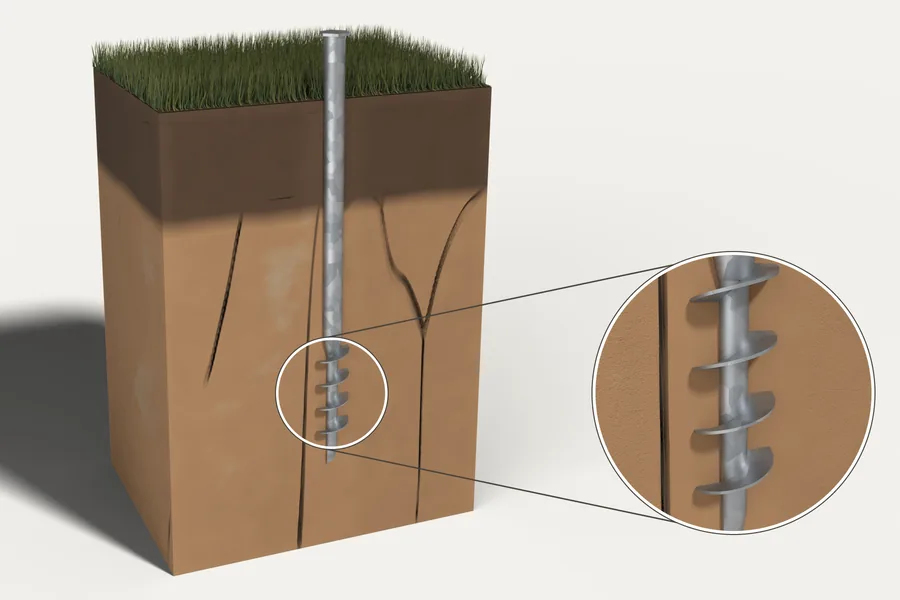
T-Block screw foundations are steel elements designed to be installed in the ground by rotation. The system does not work by simple bearing, but through interaction with the soil along the full depth of the screw. Structurally, T-Blocks can work in:
- Compression → vertical loads from the structure
- Tension → uplift forces (wind, dynamic loads)
- Shear → horizontal actions
This means all forces are handled, not only compression.
Structural behaviour compared
Load transfer
Concrete footings
- Shallow transfer
- Mainly work in compression
- Sensitive to differential settlement
T-Block
- Transfer at depth
- Combined work in compression, tension and shear
- Better suited to soils that are not perfectly uniform
Interaction with the soil
Footings
- Depend on the quality of the formation level
- Need ground preparation
T-Block
- Installed directly into the natural ground
- Interact along the whole shaft of the screw
- Less disturbance to the soil
On site
Installation
Concrete footings
- Excavation and earthmoving
- Pouring and curing the concrete
- Unavoidable waiting times
T-Block
- Installed directly by screwing
- No formwork or pouring
- Immediate connection to the structure
In many cases no heavy machinery is needed, especially for the more compact models.
Build time
Footings
- Timing tied to the full concrete cycle
T-Block
- A few minutes per screw
- No waiting time
Flexibility and project management
An often underestimated aspect is the possibility of making changes.
Footings
- A permanent solution
- Hard to remove
- Demolition and disposal needed
T-Block
- Removable
- Can be repositioned
- Reusable
This makes the project much easier to manage, especially if the design changes or a position is wrong.
Overall efficiency
Looking at the system as a whole:
- Fewer site stages
- No curing time
- Less impact on the ground
- Reuse is possible
T-Block ground screws are a more efficient solution, technically and operationally.
When to choose T-Block
T-Block systems are particularly advantageous for:
- Prefabricated structures
- Light and medium-light works
- Installations on tight schedules
- Sites with limited access
- Projects that need flexibility
Conclusion
Concrete footings and ground screws follow different construction logics. T-Block systems offer a more modern, faster and more versatile approach, with practical benefits both during installation and in managing the structure later on. See also ground screws vs concrete and contact T-Block for a technical assessment and the right solution for your project.