
Are ground screws suitable for all soils?
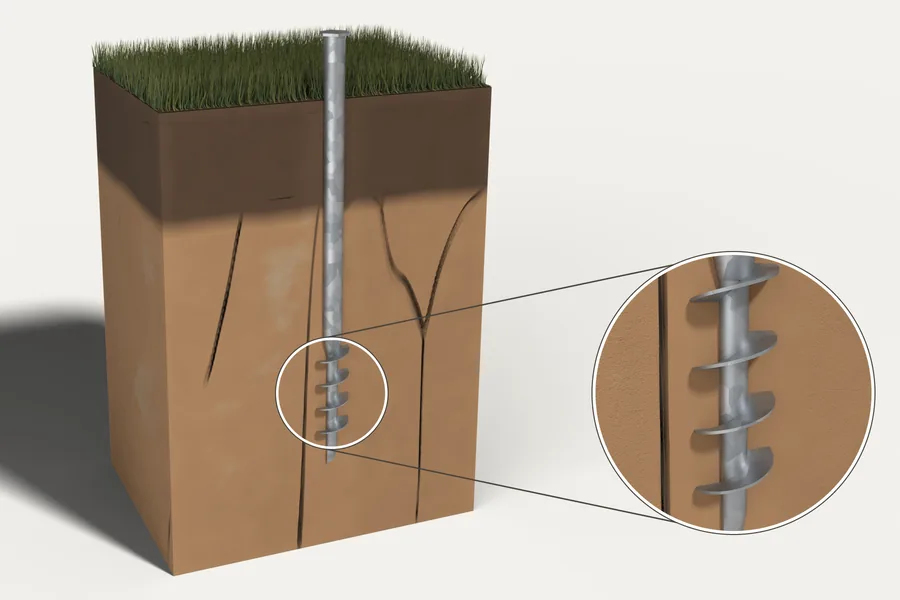
One of the most frequent questions is: do ground screws work in any soil? The answer is: in most cases, yes. Screw foundations are a very versatile, adaptable solution but, like any system, there are some exceptions.
For the overall picture (what they are, how they are installed, what they hold) there is the complete guide to ground screws.
Ground screws: a versatile solution
Ground screws can be used in many types of soil, including:
- Sandy soils
- Clay soils
- Compact soils
- Farmland
- Green areas and gardens
In these settings installation is simple and gives very good stability.
Choosing the T-Block is key
There is no “universal” screw. Depending on the soil and the type of structure, the most suitable T-Block is chosen, considering:
- Screw length
- Diameter
- Type of tip
- Fixing system
This step is essential for safety and long-term durability. See how T-Blocks behave in each type of ground on the soils page.
When ground screws are NOT the ideal solution
There are some cases where screw foundations may not be the best choice.
Very rocky ground or bedrock
In compact rock, screwing in can become difficult or impossible.
Extremely difficult ground
In special situations, a detailed technical assessment or alternative solutions may be needed.
In most cases, there is a solution
Apart from these specific cases, ground screws are a solution that is:
- Fast
- Efficient
- Adaptable
Because the most suitable T-Block can be chosen, most situations can be handled.
Conclusion
Ground screws suit the great majority of soils. Only in particularly extreme conditions, such as compact rock, may they not be the ideal solution. Contact T-Block for an assessment: we look at your ground and find the right solution for your project.


