How much weight can ground screws hold?

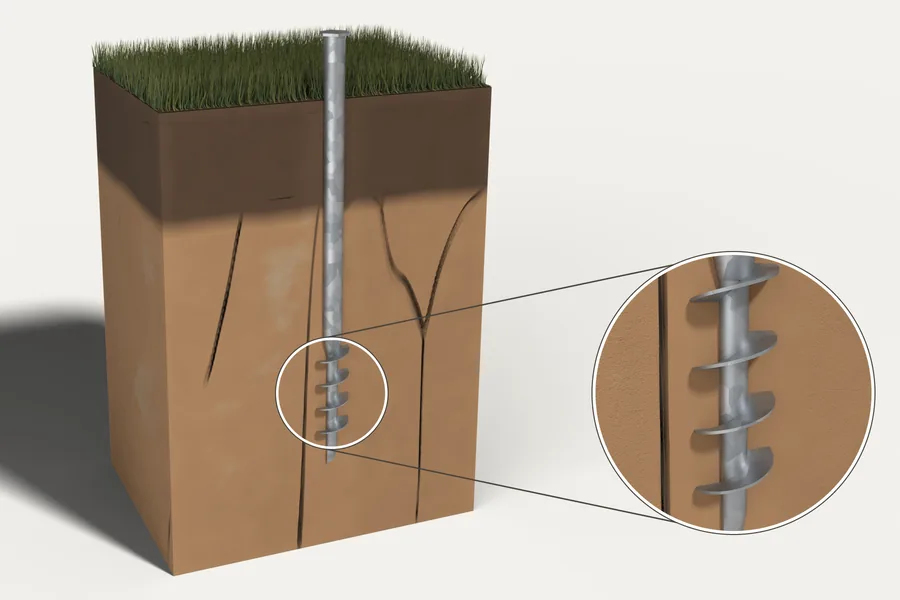
One of the most important questions about ground screws is: how much weight can they hold? It matters because it bears directly on the safety of the structure. The answer is: it depends on several factors, and there is no single value that applies to every situation.
There is no single answer
The load capacity of a ground screw depends on several things:
- The type of soil
- The size of the screw
- The installation depth
- The type of load (vertical, horizontal)
That is why every project has to be assessed on its own.
The role of the soil
The soil is one of the most important factors.
For example:
- Compact soils → higher bearing capacity
- Softer soils → lower capacity
This is why analysing the soil is always the first step.
The role of the screw (T-Block)
Performance also changes with the screw used:
- Shorter screws → for light loads
- Longer screws (1–3 m) → for heavier loads
Getting a figure for your case
The load capacity of each model depends on the soil and on correct installation, so we do not sum it up in a single number that fits everyone. For a first indicative estimate, use the configurator; for the figure for your own project, write to us.
Type of load
Not all loads are the same.
Ground screws have to handle:
- Vertical loads (the weight of the structure)
- Horizontal loads (wind, use)
- Any dynamic forces
Correct design takes all of these into account.
Practical examples
To give an idea:
- Light structures (gazebos, pergolas) → modest loads
- Larger structures (prefabricated houses) → much higher loads
What makes the difference is always choosing the right system.
How the real capacity is determined
To establish how much weight a screw can carry, the steps are:
- Soil analysis
- Choice of the T-Block
- Checking the loads of the structure
In some cases load tests can also be carried out on site, such as the compression test and the pull-out test.
Conclusion
Ground screws can carry very different loads, from light structures to larger installations. Their capacity always depends on the right match between soil, screw and structure. Contact T-Block for a technical assessment and the right solution for your project.