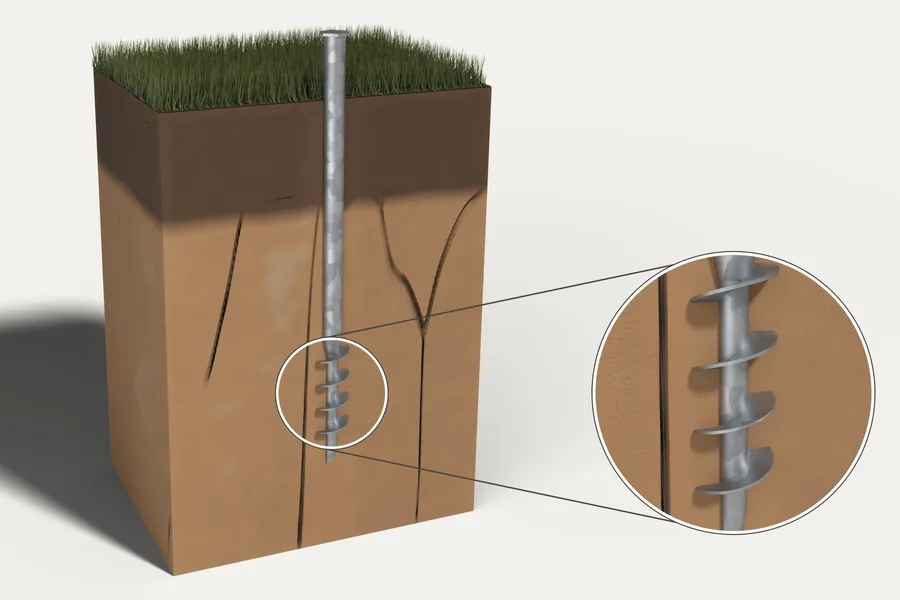
Screw-in ground stakes or ground screws: which to choose

A screw-in stake holds down a tent, a sheet or a guy line; a ground screw, or screw anchor, carries a structure: it has a head to which the leg is fixed and it works in tension too, so it holds the structure down when the wind lifts it. If you need to fix a leg, a post or a garden shed, you need the second.
The screw-in stake
It is short and thin, in plastic or light steel. It is made for tents and sheets, and it is fine for the guy lines of a light gazebo. It has no head to fix a leg to and it is not made to carry a load.
The ground screw, or screw anchor
The T-Block screw anchor is longer and sturdier, in galvanized steel, with a head to which the structure is fixed. It is screwed into the ground, needs no digging and no concrete, and works in tension too. It is also called a screw foundation or screw footing.
How to choose
- Tent, sheet, guy lines: a screw-in stake may be enough.
- Gazebo, parasol, pergola: one ground screw under each leg. For light gazebos there is the T1 kit with four 38 cm anchors.
- Fences and signs: the headless T-Block, into which the post is slotted.
- Garden sheds, platforms and decks: a grid of ground screws under the floor.
- Houses, solar and large structures: the larger series, installed with the power driver or with machines.
The right number and series depend on the structure, the wind and the ground: the configurator suggests them based on your measurements.
Do you need tools?
Up to the T6 series the anchors are screwed in by hand, with the socket and the T-handle; the T3 kit already includes the handle. A small pilot hole is always made first, which keeps the screw straight: it can be skipped only if the ground is particularly soft. At the end of use they are unscrewed and leave no trace.
Learn more
Which screw for which use, with the ready-made kits, is on the page about screw anchors for soil. If you are after the most common case, read how to anchor a gazebo on grass without concrete. How ground screws work, in general, is explained in the complete guide to ground screws.